

Music consumer innovation for music communities
-
Finding like-minded people in the music industry. These could be in your local area, or with similar musical tastes globally.
-
Building a network for musicians who support each other.
-
An organic approach to music promotion on social media.
-
Learning how to level-up your music career.
Fast and easy discovery + connection technologies
-
Find musicians you need to help finish projects
-
Search for musicians in your local area
-
See people with the same music taste
Swiping is a primitive gesture. Babies as young as 17 days old have been observed making swiping motions at objects they find interesting. In the field of app design, which often seeks to harness primitive impulses, it only makes sense that swiping would emerge as a key means of navigation.
Built for music communities – no distractions
Vamps
-
Promote releases
-
Share demos
-
Showcase works in progress
-
Give announcements
-
Discuss musings and ideas
-
Vlog your experiences
-
Display artwork
-
Do anything else that you think your music community needs to know!
Hybrid sync representation and music publishing model
Keep 100% music distribution royalties
Conclusion: why Vampr
Today we are delighted to share with you that Vampr has been shortlisted by Music Week for an award in Music Consumer Innovation 🎉
The competition will be fierce, going up against Amazon Music, Deezer, PIAS, Spotify and TikTok, however it’s a genuine achievement and honor to simply be named alongside these music giants 🙏
You can check out the full shortlist here: https://www.musicweek.com/labels/read/music-week-awards-2021-finalists-revealed/083506
Winners will be announced at the awards ceremony on September 14, 2021 in London.
Josh ✌️
Now you can post video, audio or image updates to all your followers – and the world
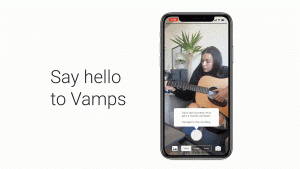
Vamps are ephemeral posts at the top of your feed. They can be anything you like – a new demo, a reflection on your day, or just a selfie! Get creative.
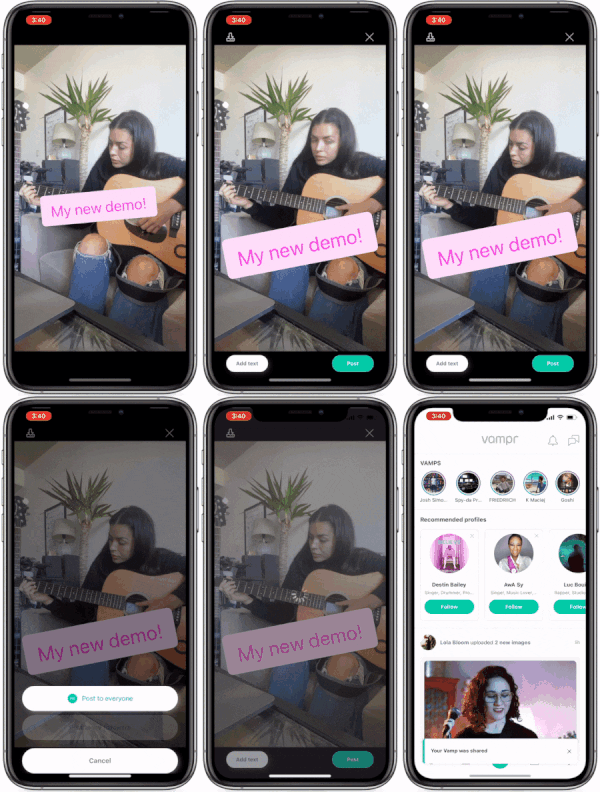
Send to followers
Upload or record unlimited videos, images or audio notes for your followers to enjoy. See exclusively who is watching and liking your updates.
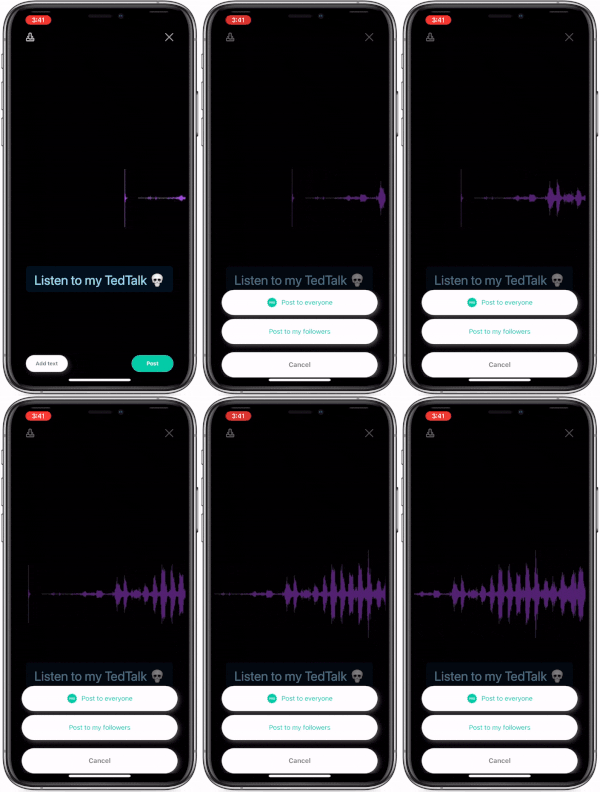
Broadcast to everyone
In a first of its kind social feature, share your update with all active Vampr users – perfect for promoting your latest work of art*
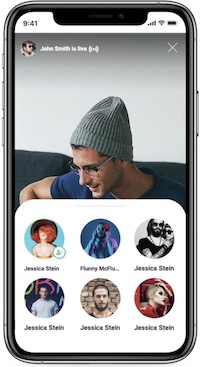
Live Vamps
Stay tuned in the coming months for live video and audio Vamps where you will be able to broadcast in real-time to everyone online…
*Broadcast to everyone feature is available only with Vampr Pro subscription or through in-app purchase
-
Adding collaborators to an existing work
-
Signing a sync deal to place your music in a film production
How to get music copyrights
Music intellectual property rights
Different copyrights protect recorded music
There are 2 different copyrights that protect recorded music:
Master rights
-
Vinyl records
-
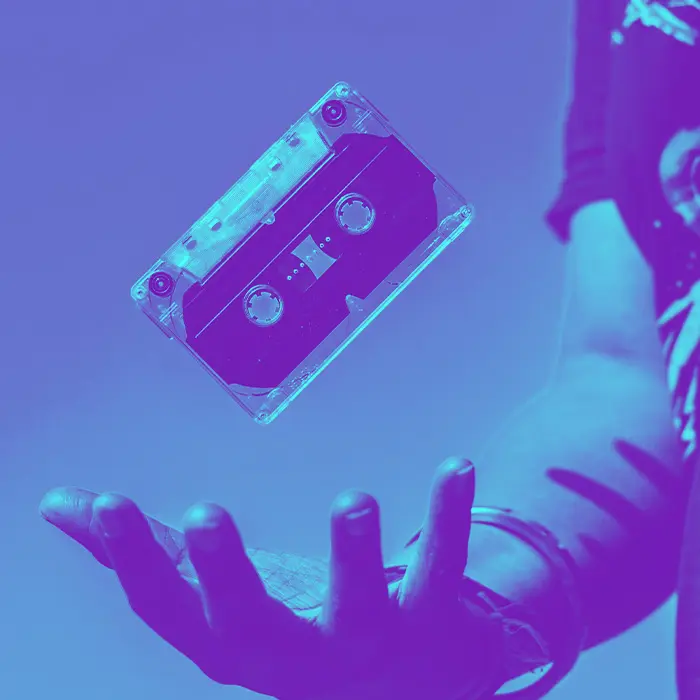
Cassettes
-
CDs
Publishing rights
- On the radio
- In some syncs (see below)
- Live
- In large venues
- In bars, coffee shops or retail stores
Sometimes, only registering with one local PRO can limit the royalties you’re receiving. This can be because you’re only collecting half (writer but not publishing) royalties or because your PRO doesn’t collect from some overseas territories.
Using a service like SongTrust can ensure all of your royalties are collected worldwide. Our friends at Music with Flavour have written a great article about registering with SongTrust as a writer.
Types of music licensing
-
Master license – the right to use the recording of a piece of music or song
-
Sync license – the right to use a piece of music or song in a film production. This requires permission from both the master and publishing copyright owners
-
Publishing license – the right to perform or record a piece of music or song
-
Performance license – the right to perform music in public
-
Mechanical license – the right to reproduce and sell a recording of a piece of music or song
Who needs a music license?
-
Your music in Movies, films, documentaries, tv shows, games, adverts and trailers. This is called music synchronization, also known as sync or synch.
-
Radio has the right to play music because they pay a license to performance rights organizations. (Sometimes under what’s known as a blanket license).
-
Any businesses, premises or venues playing live or recorded music need a license.
-
Content creators, such as YouTube vloggers or Podcasters need to license music.
-
Social media platforms allow users to create posts that use music.
-
Record labels need to license the right to use the publishing copyright to create a record.
-
Artists, topliners and rappers who want to license a backing track to sing over.
-
Producers who “sample” or remix music to repurpose it in a new derivative work.
-
Artists who cover music created by other writers.
Exclusive and non-exclusive music license agreements
Sync license for music
One-stop music licensing
Brand exclusivity
Production music
-
License the music out
-
Collect royalties
-
Maintain brand consistency
-
Pay composers a set fee for their work, sometimes hiring them on a salary.
Conclusion
-
Overcome creative blocks
-
Build a support network
-
Collaborate with you to help finish projects
-
Inspire you to try new things and learn new skills
-
Challenge you to go out of your comfort zone
-
Share your music with their fans
-
Become close friends and share like-minded sentiments
-
Rent gear or studio space
So, to help inspire you to get out there and meet new people, here are 6 key examples of music collaboration opportunities that occur on Vampr and in the wider music industry…
6 crucial music collaboration examples to inspire you
- Singer songwriter looking for producer
- Songwriter looking for singer
- How to find band members
- Looking for an artist manager
- Producers and musicians
- How to find a mixing engineer
1. Singer songwriter looking for producer
2. Songwriter looking for singer
If you think singing somebody else’s song isn’t for you – give it a go! What singer doesn’t love karaoke? 😏
3. How to find band members
Consider potential professional problems that could come up in the future. Band members should sort agreements (such as royalty splits and commercial decisions) up-front.
Bands looking for singers should get searching their local area on the Vampr app now!
4. Looking for an artist manager
Finding an artist manager is making a decision to have somebody take care of a lot of your networking needs.
Managers can network with:
-
Remixers
-
Music Producers
-
Musicians
-
Singers
-
Songwriters
-
Executives and all manner of other professionals.
Managers keep bringing artists work that fits their artistic direction and commercial strategy.
Music managers looking for talent can also slide into artists DMs on Vampr.
5. Producers and musicians
Producers don’t only work with singer songwriters and topliners. They often also need professional musicians to replace tracks in their production. Often, they use placeholders (such as MIDI tracks or amateur/sloppy playing) to get an idea down. They then use musicians to record a proper version.
Musicians also make instrumental song demos that need full productions. Finally, musicians often need remixes or edits for another use (such as for sync).
6. How to find a mixing engineer
Of course, producers often have a blend of creative and technical skills. But they may not always have the time, equipment, patience or sometimes skill, to mix their own tracks.
Finally, musicians and artists do often produce their own music. But, there are many reasons to consider mixing and mastering professionals:
-
Treated rooms made for transparent replication of sound
-
High quality monitor speakers
-
Extensive knowledge when it comes to music dynamics and frequency balance.
Conclusion
There you have it! 6 examples of crucial music collaborations always needed in the music industry.
Music collaboration is what can take your song from demo to finished product. Or, finished product to hit record! Always consider what might be missing from a song and who could help you take it to the next level.
Vampr Pro gives you unlimited connection opportunities to find collaborators locally or worldwide. Try Vampr Pro now! ✌
Horizontal music networking is a term used to explain networking “across”. This is opposed to networking “up”, such as to people already in higher positions in the industry, or with more commercial success.
Networking horizontally means networking with people who are accessible and at the same or near levels of success to you.
This may be your friends in the music industry, independent record labels and music publishers. It could also be other artists (at your level) and music bloggers who focus on new independent music.
To dive deeper on horizontal music networking, let’s explore some more context of music networking and what vertical networking is.
Networking in the music industry
Networking is an increasingly important skill in the music industry.
Think about who you need to network with and also how you network well. Being polite, not overwhelming people and bringing value are important online and offline.
Successful networking brings compounding opportunities. The more people you know and manage a relationship with, the more chance for an opportunity to come from the connections.
So, both quantity and quality are important, but focus on the latter will produce the fastest results.
Adding more networking into your music business strategy will be enough of a starting point for some. For those who are already networking who want to go a bit deeper, horizontal networking gives an even more focused approach to success.

Vertical music networking
Not always rightly, the idea of success is heavily intertwined with our status and “position”. Vertical networking is a tendency (and sometimes strategy) to only try to network with people who are in a higher perceived position. Many people network “up” to try and be surrounded by people more successful in hopes they will get a ladder up.
The most obvious example of vertical networking in the music industry is trying to network only with high-status musicians, producers, gatekeepers and A&Rs.
The problem with vertical networking is constantly hitting obstacles that stop you getting to your opportunity or goal.
It also gives somebody else the power to control your success, commonly known as gatekeepers.
This ideology has been cemented in typical corporate careers. In the old-school career, you would enter a company in an entry-level position and would have to go through multiple levels of management before accessing the chiefs of the company.
Over decades, you would work your way up through your career by being promoted into higher positions, giving you an increasing access to “higher tier” contacts. This is a reality that clearly influenced the famous Nosedive Black Mirror episode.
As commercial opportunities in the music industry are finite and music is abundant, gatekeepers need to prioritise and protect incoming workloads. As such, there will probably always be gatekeepers who aren’t interested in what you have to say until you make a sufficient noise.
So, networking “up” in the music industry is a real battle.
There are many other people fighting the same battles as you might be; with so many variations of talent, skill, interest and passion. Therefore, the music industry might be the easiest industry to network in horizontally!
7 ways to use horizontal music networking
With horizontal networking, everybody gives each other a leg-up and everybody succeeds faster. In other words, it’s a support network as well as a route to find and generate opportunity.
You can compound your success by bouncing off of smaller opportunities towards bigger goals. More quality connections means more smaller opportunities = more bounciness! ⛹️♂️
1. Use networking to obtain new important information
The first benefit of horizontal networking is information.
When you’re working in the music industry it’s easy to become overwhelmed by the different skills and knowledge there is to learn. Acquiring all of this knowledge and knowing how to use it can take a lifetime.
Luckily, different people naturally develop different skills at different times. As such, having friends who are doing things that you are not can help you focus and stay in your lane. Knowing you can pull on them for help when the time comes expands your ability to succeed faster.
Additionally, many different people around you might have already had an attempt at something you’re trying to achieve. They will be able to give you information on what they did well or could have done better that you can consider for your own approach.
2. Utilise people with immediate skills you don’t have
Struggling to finish a song because you need a skill you don’t have?
Skill development, learning a new instrument and studying music business all have huge learning curves and take time. So, you might be able to cut a lot of that time by collaborating.
Maybe your electronic drums sound too fake for the song? Maybe your MIDI composition just isn’t quite amazing because it’s missing a real guitarist? Are you a singer/songwriter who needs a producer? Do you need mixing or mastering? Then, collaborating is your answer. (Get on Vampr and get swiping for free!)
Working to complete a project is probably the most obvious reason for networking in the music industry. Unfortunately, musicians often create obstacles for themselves by thinking that high-budget professionals are their only option. Often, a substantially talented collaboration could be right under your nose, waiting for their opportunity to blow just the same as you!
3. Cross-promotion and fan-sharing
This one is definitely overlooked! Having a strong network of other artists who are building and growing at a similar rate gives an awesome opportunity to exchange posts on social media about one another.
This gets really creative when thinking about inviting other artists onto your live streams, on socials for chats, for interviews and even jams!
All of this will also lead to future tour support and gigging opportunities.
4. Empathy and a support system
Working with people at a similar level to you means that they may be feeling or experienced similar pains to ones you are. Consequently, they will likely be able to give you advice and support to guide you how to regain clarity over your next steps.
Expanding this idea, many professionals create ‘mastermind groups’, a concept coined by Napoleon Hill in his book “Think and Grow Rich”. (Essential reading for anybody looking for a “success blueprint”). This might be something you want to do with your fellow music comrades.
5. Inspiration and motivation
Trying to get to the top of the mountain in one go is going to cause a lot of burnout, frustration and feelings like you won’t succeed. Instead, planning your journey to do a stretch at a time can make the journey enjoyable.
Working with people who are levelling up at a similar pace to you will allow you to keep inspired. As a result, you’ll be able to stay focused on your micro-goals and stop and smell the roses along your way.
Comparatively, consider trying to network with people who come across as inaccessible and ignorant…
Networking is a much nicer experience when you’re doing so with people who are passionate and welcoming.
6. Recommendations and tip-offs
Regularly connect with your network and keep them up to date with what you’re working on and aiming for. By doing this, you are inviting them to share opportunities with you that fit what you’re striving towards.
This is most effective when you are the one proactively sharing opportunities. What you give out always comes back. 🥰
7. Future-thinking
Everybody who is working hard, learning how to solve more problems and achieve more of their personal goals is going to level-up.
That means, in 5 years – a lot of your network is going to be in higher places.
It’s important not to look at your network as any lower in value than people in higher places already. In general, see the potential of your peers, not their limitations. Work together through your strengths and weaknesses to succeed from your own efforts!
The more people creating opportunities, the less power those at the “top” will hold.
What’s your music networking strategy?
Vampr is the easiest to use, not to mention largest, social-professional network of music industry contacts in the world. If you’re not already using Vampr, download it for free today and start swiping and connecting with people in any country to kickstart the growth of your network and team. ✌