

New York City
Popular Music Venues in New York City
- Beacon Theatre
- Radio City Music Hall
- Madison Square Garden
- Blue Note
- Kings Theatre
- Le Poisson Rouge
- Elsewhere
- Brooklyn Bazaar
- Forest Hills Stadium
Los Angeles
Popular Music Venues in Los Angeles
- Hollywood Bowl
- Greek Theatre
- The Echoplex
- Club Nokia
- Walt Disney Concert Hall
- The Wiltern
- El Rey Theatre
- The Orpheum Theatre
- Troubadour
- Hollywood Palladium
Austin, Texas
Popular Music Venues in Austin
- Elephant Room
- Little Longhorn Saloon
- Broken Spoke
- The White Horse
- Donn’s Depot
- Carousel Lounge
- Paramount Theatre
- Mohawk
- Continental Club & Gallery
- Hole in the Wall
Nashville, Tennessee
Popular Music Venues in Nashville
- FirstBank Amphitheater
- Analog at Hutton Hotel
- Grand Ole Opry House
- The Blue Room
- Ruman Auditorium
- The 5 Spot
- The Listening Room Cafe
- Bluebird Cafe
- Springwater Supper Club & Lounge
Atlanta, Georgia
Popular Music Venues in Atlanta
- Chastain Park Amphitheater
- Lakewood Amphitheater
- Vinyl
- Terminal West
- Center Stage
- The Masquerade
- 529
- Aisle 5
- The Loft
7 Business Professionalism Tips For Musicians
Be On Time
Have A Professional Attitude
Come Prepared
Communicate Effectively
Follow Up
Invest In Career Development
Network
Here is an exclusive interview with Dorian Perron! Hope you enjoy.
- Can you tell us a little bit about where your journey with music started and how it led to co-founding Groover?
Of course! I started as an indie music blogger in 2013, sharing music that I liked and thought didn’t receive the attention it deserved. I also organized live acoustic sessions at my place and live shows in Paris with indie rock musicians such as Ryley Walker, Plants and Animals etc. It was more passion than a job, but the virus caught me (not the one you’re all thinking about ;)). I met with my co-founders Romain & Rafaël in California in 2018, they had music projects and had struggled with getting their new tracks heard from blogs, radios, record labels etc. On my side, even knowing my blog Indeflagration was small, I was receiving over 100 requests per day from artists and their representatives wanting to get their music featured!
When we met in California, we wanted to help independent artists, that was for sure. We knew they had problems and wanted to do everything at once. But instead of going right into it, we started by taking phone calls with more than 200 musicians and music industry professionals for a full month, and we understood very quickly that the most major issue they were facing was related to the nightmare they were experiencing to promote their music and try to get heard. That’s why we created Groover.

- What is the Groover origin story? Where did the idea come from and how did you go about making it a reality?
Through those calls and meetings, it was not hard to realize that artists needed help in order to stand out from the crowd when supposedly 80,000 new tracks are released each day on Spotify. We realized that the biggest bottleneck exists after the track is created, recorded, mixed/mastered. The barriers to production and distribution are already brought down thanks to production software, streaming platforms and digital distributors.
That’s why we created Groover when we came back to France from California. Our goal from the start has been to help artists emerge through influential channels such as blogs, radios, playlists curators, starting with guaranteeing that their music would be listened to and that they’d receive feedback. To help them break this wall of the first listening that could change things, and sometimes change everything.
- What does Groover do for up-and-coming artists and how do they go about getting started on the platform?
To say it short – be ready for the sales pitch 😉 – Groover is the web platform that helps artists get their music heard. Groover connects artists who want to promote their music with the best curators, radios and labels seeking emerging talents.
To get started, it’s easy! You can add a Youtube or Soundcloud link to the track you’d like to promote, and send your music directly to a selection of blogs, radios, playlist curators, record labels and pros of your choice, get feedback guaranteed, build your network and increase your visibility. Feel free to have a look at this short guide to get started easily on Groover
.
- Who is Groover for?
Groover is for all independent artists who want to get more people to listen to their music, to build their network and progress. We’ve been amazed by the kinds of artists who have used Groover to increase their coverage through blogs, radios and playlist curators so far, from amazing projects such and labels as Nico & Vinz, Tchamy, La Femme, to complete discoveries and artists releasing their very first track. You can even use Groover to get detailed feedback on your unfinished track from mentors and sound experts, and also get in touch with record labels, publishers & managers.
Let’s also note that Groover is also a great tool for artists representatives such as managers, record label owners, publishers. They can capitalize on their recurring use of the platform to target even better the right contacts for all the artists they work with.

- What kinds of opportunities in terms of feedback and exposure do artists receive through Groover?
What Groover guarantees is that artists will get their tracks listened to and feedback from the curators and pros they’ve reached out to. If some don’t answer after 7 days, the artists get Grooviz – the name of our credits on the website – back. The current answer rate on Groover is around 90%. This means that if you send a campaign to 40 contacts, you’ll get in average 36 answers and get Grooviz back to send your track – or another one! – to 4 more music curators & pros of your choice.
You must wonder what kind of feedback you can expect. All the curators & pros have to agree to a charter before they’re approved on Groover, and to several principles. The most important ones are: be informative and constructive, explanatory and sincere, benevolent and encouraging. We want artists to get value out of the feedback they receive, be pushed forward, either understand how their music is perceived or find ways to improve.
The content of the feedback depends a lot on the types of curators you’re reaching out to. Mentors, sound specialists, record labels, managers will naturally tend to be more detailed and comment. On the contrary, radio stations and playlist curators sometimes have trouble judging a track on top of saying it’s a fit for their list or not.
More interesting of course is the fact that curators and pros can share the tracks they receive or get in touch with the artists. It happens on average in 20-25% of the cases, with huge variations based on the quality of the music and the accuracy of the targeting. Since Groover started, there have been more than 1 million pieces of feedback given, 250k shares and more than 500 signatures with record labels… That we know about!
The artist dashboard gathers all the replies obtained by artists from the curators & pros which they have chosen to get in touch with on Groover
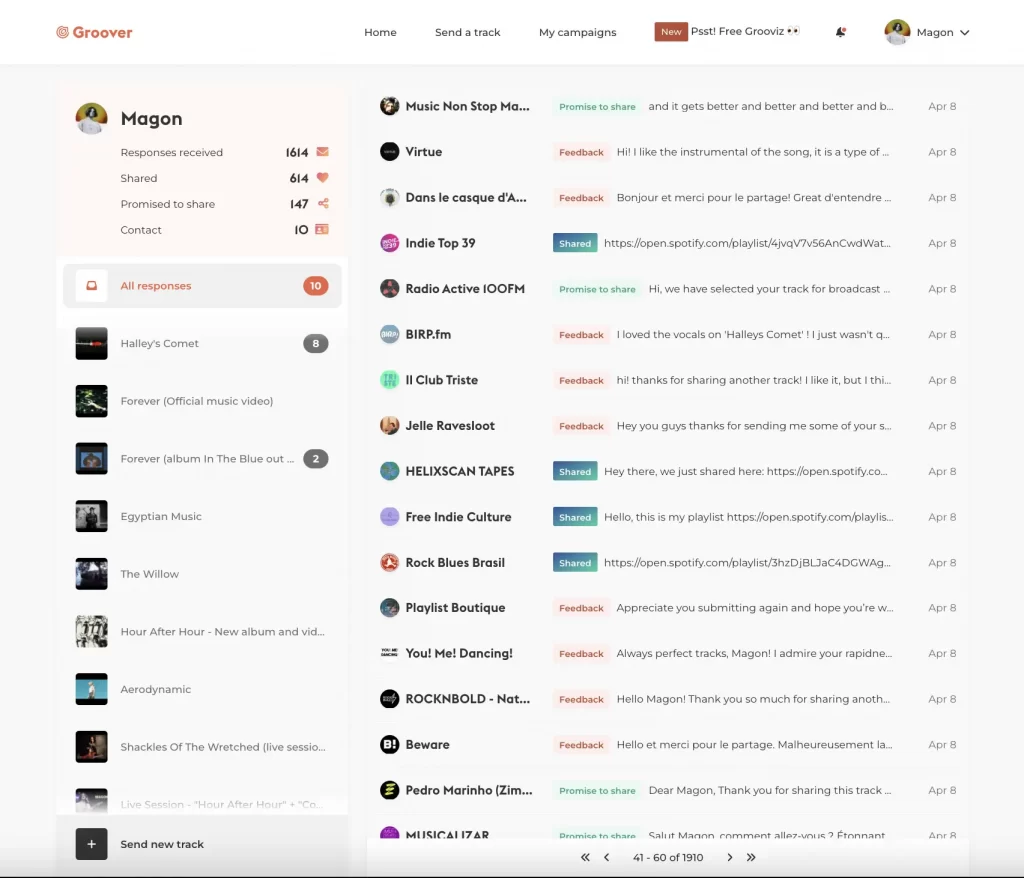
The artist dashboard gathers all the replies obtained by artists from the curators & pros which they have chosen to get in touch with on Groover
- From the curator/pro side, what are the advantages of applying to be on the platform?
I’ll say it shorter on this one haha 😉 First, they get the tracks in an optimized dashboard which is as easy to use as a playlist, they can make their decision and share the tracks they like through it and save a lot of time. Second, they get high quality music much more in their editorial line since we guide artists to choose the most relevant curators and pros for them. Music curators & pros on Groover tend to receive really amazing music on the platform! Third and last, they get paid for each reply they give, whatever their decision is. So they keep their complete editorial independence while discovering new music gems at the same time.
- What are some of the accomplishments you’re most proud of with Groover?
So many… I mean, so many things I wouldn’t have imagined would happen! Starting with how the team evolved, with now more than 35 people working for Groover who amaze me and my co-founders Romain and Rafaël every day.
And also of course there’s nothing more satisfying than witnessing artists who’ve been using Groover from the start getting amazing results, making life changing encounters, building their team through the platform… And killing it on stage! Our artist accelerator Groover Obsessions is also particularly dear to me as it was a dream to be able to help artists boost their careers even further. The 30 artists who are part of it are family now, and we have a team of 5 working every day on pushing them to where they deserve to be.

- As someone established in the music space, what advice would you give yourself when you were just starting out?
Oh, I know! People are extremely creative in the music space, it’s extraordinary. But on the contrary, you won’t find as many people being very… let’s say… organized. When I was doing my studies, I started a small music blog and I was able to obtain so many free festival passes, vinyl discs, CDs just by sending professional emails detailing exactly what I was going to do in return. More generally, this also has to do with the fact that the music industry can be much more open to newcomers than other industries, especially on the “pro” side.
So the first piece of advice would be: always try, you’ll never regret it. You can try to get in touch with whoever you want in the music space, nothing can stop you if you’re nice, professional and if you know what you want!
The second piece of advice, especially if you want to start a service/platform would be to talk to the people you’re trying to address. Before starting Groover, we interviewed more than 200 artists and music professionals, long and detailed interviews that led us to understand how much promoting your music as an artist was painful and how game changing it would be to solve that issue.
We hope you liked our exclusive interview with Dorian Perron!
Want to try Groover out? Pirate users can now enjoy a 10% discount. Sign up on Groover and use the code VAMPRGROOVERVIP [more explanations on how to apply the special discount here]
Follow Groover on Instagram and Spotify

Ever had that dream where you’re late for school, it’s time for final exams and you haven’t studied at all? It’s a common nightmare, but next time it happens try imagining this instead: You’ve just come home but your house is different somehow, finer, more inviting than you remembered it being. You know it’s OK though, because in this dream you have already completed your music education.
You’re in your front hallway, looking at the framed photos on the walls. You’re in all of them, different versions of you. You’re playing music, you’re performing to crowds, you are completely absorbed in front of a bank of lighted control panels in a studio. You are behind a mixing board, you are laying tracks inside a maze of soundproof panels, looking very satisfied surrounded by a group of people who are all smiling with you fondly.

Music Education
Want to make your dream come true? You have some work to do first. Here’s where some real music education comes in. It’s not in some alternate universe where you were born to famous and wealthy producer parents. It’s not in some intimidating and expensive professional music school. It’s a dimension of practical industry education that you can access anywhere: Welcome to Vampr Academy.
Module 1
Let’s look at the evolution of this new world and see what resonates with you. In the first module, Thinking About the Business of Music you’ll be introduced to your coursework, and the teaching philosophy that you’ll be interacting with while using the Vampr system of themed dynamic lessons.
This first group of classes is a great place to start to gain a deeper understanding of music business roles and the unique fit and function of artists within it. You’ll gain insight into a rich range of options and learn to work your own magic with the guidance of solidly experienced professionals you deserve. This is where you learn about the music consumer, how to get inside the listener’s head and propel your sound to a wider audience.
Module 2
Legal Basis of the Music Business leads you with sure and steady steps through the complicated realm of intellectual property and copyright issues in music. You’ll learn how to think critically about copyright both domestic and international and spot the myths that throw many artists off. Knowledge is the surest defense against copyright infringement to protect your original work. You will also grasp an invaluable understanding of mechanical royalties, trademark, branding, domain names, social media and image rights. Assignment and licensing will be covered as well as the role of PROs.

Module 3
The third module Understanding Music Publishing tackles the development and fundamental business side of current music publishing including synchronization, working with publishers and sync agents and how you can turn your songwriting into a steady stream of income.
Module 4
Recordings and Record Companies will explore the four pillars of the recording industry and measure the impact of the digital revolution. You’ll be guided on a deep dive of lessons covering the functions of the record music industry, record music income, digital distribution, label services and much more. This module spans across 7 lessons and is the perfect stepping stone to help you along your path of truly understanding the inner workings of the recording world. You will be fully up to date on the recordings industry’s functions and terms. Also, one more little thing—collecting the money.

Module 5
Contracts and the recorded Music Industry uncovers all the secrets to getting that elusive and lucrative deal as well as clear understanding of various types of recording and publishing agreements. You’ll gain insight on bargaining position and how to fine tune your internal compass for negotiation. You’ll be taught to reliably consider when you should “sign your life away” (or simply run away screaming), and you will know all you need to about the reversion of copyright and catalogs. We’ll show you why longer contracts or bigger money isn’t always better. We’ll cover advances, contracts for services and key clauses in recording and publishing agreements. You’ll learn the subtle martial art of defending yourself against any irrational or unjust behavior that you might confront on your journey.
Module 6
Here comes another jungle to conquer in Module 6, with our Overview of the Live Music Industry. This will bring you into the arena of economics within the live music industry and to contemplate the concept of music as a perishable good. You’ll also study the main players in the live game, such as venues, venue bookers, agents, promoters. You’ll consider the truth about promoters and music as its own reward. The goal here is to give you the tools to establish your own live team.

Module 7
Representation and Management is the core of Module 7, its legal basis and everything an artist looking for a manager needs to know. You’ll look at management business models, learn the role of a manager as well as the types of managers. Contracts of term, territory, commission and termination will be covered, as well as how to evaluate a management’s fee for service.
Module 8
Here we are at long last with the final module of this series, Bringing Together Your Music Business, and you should feel proud of all your hard work as you approach your moment of groundbreaking. You’ll be ready to consider what it is you actually want to market, your artistic brand, your plan and publicity. You will refine your design for sustainable success, learn financial planning, how to build a solid business team, as well as what to do when as they say the honeymoon is over. Don’t worry too much, though. By now you’ll be prepared. For anything.
VAMPR Academy is the future of music education. Are you ready to get started?
As one half of the songwriting and production duo Saltwives, David Phelan boasts an impressive catalog with his partner Alex Oriet. The two have worked with some of the biggest names in popular music. Their most recognized singles include: Zayn and Sia’s single, “Dusk Till Dawn,” to Bebe Rexha’s single, “No Broken Hearts” ft. Nicki Minaj. The songs written and produced by Saltwives have garnered over 5 billion streams worldwide and the duo earned a BMI Award for the US Top 10 “Remind Me To Forget”performed by Kygo and Miguel.
London-based world-renowned music producer Phelan joined Vampr for a live Q&A session last month and shared his tips on making it in the music business. “Create, network and then create and network some more,” he advised listeners during the session. Here are a few more helpful tips he shared that can help you move your career forward.

Perfect Advice From David Phelan
Write songs that are catchy or elicit emotion. “I think the main things have to be emotion and catchiness. Either the song is so catchy it does not have to have strong emotion or communicates so much emotion it doesn’t even have to be that catchy! Normally somewhere in the middle of that is great. If you don’t have either, write something else.”
Use constructive criticism when collaborating. “I’m very grateful to have had an excellent working relationship with Alex for many years now. We have no set way of working, we just follow each other’s enthusiasm and have healthy arguments about who’s right. The best way to prove that is by coming up with something else rather than trashing what is there. That tends to mean you can stay friends.”

Be dedicated to songwriting & you will hit upon success. “Every now and then the stars align and I get shivers from the song, that’s when something has turned a corner and become very special. It’s a very rare occasion, but when it does, I have full faith in the song and won’t give up on it, no matter how long it takes to figure it out. That can mean changing the production 10 times or more, finding a different singer, tweaking the song, whatever makes it better.
Most career advancements come from a mix of luck with constant grind. “I think it’s a bit of both for sure. You can definitely control how much you grind and to a smaller extent you can create your own luck also. By trying to put your grind in the right situations, by contacting people, grinding in isolation is hoping only to get by with luck and that might not always play out.”
Stick with it. “I think the number one thing I notice when I work with new people is that the biggest determining factor in whether we continue to work with them can be their enthusiasm and stick-to-it-ive-ness. Cultivating those skills is so important. So many people starting I’ve thought were musically talented, but then after we worked together they never send me more ideas or follow up. They expect maybe I don’t want to hear from them or whatever, but the truth is I really value people who communicate ideas. Even if the ideas are not great, as long as they are improving then I’m interested.”

Take responsibility for the work: “I appreciate collaborators who have complementary skill sets, creative honesty, and people I enjoy hanging out with people who take personal responsibility for what we are making. Also sometimes when I’m working with new writers and artists, they can lean back a little and expect the more experienced people to take care of making sure the song is great. You should always aim to take responsibility for the song you are working on, even if you are a first time songwriter with the world’s biggest hitmaker people really appreciate that effort.”
If you didn’t know who David Phelan and Alex Oriet were, you do now. You should definitely take their advice when it comes to music and the industry because they certainly know a thing or two!
Criticism can make or break the way a musician feels about their own music. Letting music you’ve worked so hard on out into the world can be exhilarating but also give rise to uncertainty. Some people will love your sound, but others will have complaints and suggestions. You can rely on members of either camp being eager to share their thoughts. Take these constructive criticism examples and learn from them to adapt without getting upset!
Exposing your work to judgment as well as to praise is essential for creative growth but isn’t always painless. Hearing what other people think is good or bad about your sound, having your strength or weakness as an artist openly evaluated can be a dizzying process. The message of positive feedback is that no changes are necessary, that your song, your performance, is perfect as is. Feedback suggesting improvements could feel more negative, even discouraging. Recognizing an opportunity to use challenging feedback to make changes in your music can transform your career.

Any feedback is ultimately good because it means people are listening, but an uninformed critique isn’t always useful for a creative. Enthusiastic praise for a painting in an art show coming from the artist’s mother isn’t likely to be taken seriously, nor is a more scathing opinion of the same art offered by the painter’s angry ex. It’s criticism from an objective impersonal listener that can play a huge role in helping the artist improve.
Compliments and praise can fuel your drive to keep recording or performing, but it’s impossible to open the door for positive attention without also letting in your less adoring fan base of potential critics. It doesn’t take a degree in music theory for someone to express their opinion of a live show but absorbing feedback merely as good or bad does little to fertilize new growth. For bands without much experience playing live, or bands that mainly record without the immediate reaction of a live audience, constructive criticism examples can be extremely helpful.

It’s been said it takes 10,000 hours of practice in order to master a skill. Any musician can put in 10,000 hours of practicing their instrument, but it would be nearly impossible to spend that number of hours performing on stage. Learning to implement changes to your on-stage performance based on criticism can be a clever way to become more professional without touring as frequently as the Rolling Stones.
For any aspiring professional in the music business, learning how to accept criticism, to think of it as a gift rather than a judgment, is a vital ability if you want to succeed. To thrive in such a competitive field, you need to be able to turn an awful lot of people into fans. A painter doesn’t need 500 thousand avid fans trying to buy every sketch they make, or to follow them from city to city to watch them paint. A sculptor doesn’t necessarily need to cultivate a sizable audience in order to achieve acclaim. These artists only need a small group of wealthy art fans or a community that values their work enough to turn an empty space into an art gallery where people can come and take in their creation. To have a career recording and performing music, you need to appeal not only to followers of your music genre but also make converts out of those that would least identify as fans of the type of music you play. A jazz saxophone player would want not only jazz devotees to appreciate their sound but hope to be able to turn all sorts of music lovers from rock to hip hop into fans.

Successful artists will tell you that every new achievement builds on the last. The satisfaction they get from their work is equal to the amount of effort and passion they pour into it, using every tool at their disposal and all the help and inspiration they can possibly muster. The ability to improve your music through thoughtful consideration of the constructive criticism examples you receive can be almost like having a cheat code on a video game, a life hack from an unexpected source. Learning to gracefully process criticism and putting that information to good use is a skill that we could all learn to apply better in our lives.