

In a world-first collaboration, Vampr has partnered with Music Victoria to provide paid Music Victoria Essentials (and above) members with a 6-month subscription to Vampr Academy.
Led by Andrew Watt, Vampr Academy provides the backbone ‘Music Business Essentials’ course (consisting of 53 lessons and 17 hours of content) along with a ever growing set of Deep Dive courses on subjects such as Management, Record Contracts, NFT’s, Mental Health for Musicians and Team Building.
In addition to Vampr’s world-class courses, Music Victoria members will have access to a growing collection of exclusive Vampr Academy interviews with industry experts, live Q&A sessions and a free subscription to all Vampr Pro features, and much more.
More here 👉 https://www.musicvictoria.com.au/music-victoria-announces-new-professional-development-offering-with-vampr/
Topic: Charting globally as an independent artist.
Couldn’t make it to Vampr’s Accelerator Session with Emanuel Brown back on August 7th? No problem, we have the chat transcribed for you so you can re-live the conversation and get all the wisdom that he dished out! 🍽
Vampr: First I’d like to say thank you so much for joining us today, Emanuel! Could you give us a little background about yourself :)?
Emanuel: No Problem and thank you Vampr for having me! My name is Emanuel Brown and I’m a Hip-Hop Artist / R&B artist from Newport News, VA I currently live in the Seattle area.
Vampr: So you’re from Virginia and have lived in Seattle for a while now – what initially drew you to Seattle, was it the music scene? And how long have you been working in music?
Emanuel: So I never thought I would land in Seattle but I was in the navy which is what brought me here. I’ve been working in music professionally for over 7-8 years and creating music for over 20 years.
Vampr: Hell ya!! So creativity is really in your bones, love that. What do you think is the most important aspect to keep in mind when moving cities especially when you’re trying to pursue your dream?
Emanuel: I think knowing why you’re moving is important and that starting over isn’t a bad thing. Also, I think you shouldn’t be afraid to go out and find ways to learn about the area and what kind of music city you’re in.
Vampr: Absolutely! We know a thing or two about networking you probably could’ve used an asset like Vampr when you landed in Seattle – lol. How did you go about networking when you got there?
Emanuel: Absolutely Vampr could have helped with that and I’m glad I learned about you guys. So I just learned where the music venues were and would go to shows. Hip hop shows, R&B shows, etc. Sooner or later you start seeing the same people and realize who’s who.
Vampr: Right, so just making friends and not expecting things from people?
Emanuel: Exactly, I feel like going into anything with expectations can come off not genuine.
Vampr: 100% I think people forget networking horizontally and creating your ideal community is important. So Who would you say helped inspire you to get into music and who are your biggest influences in music at the moment?
Emanuel: Exactly! I think no one inspired me directly but more of the impact of what someone’s words can do to change your mood was where I saw the value and I know I have a lot to share from my life that can help someone else. Some of my biggest influences are J. Cole, Pusha T, H.E.R. and Anderson Paak. To name a few.
Vampr: SOLID list of influences, FR, and what are some aspects of influence you look at? Like is it their storytelling, their beats, or the emotion both of those things invoke?
Emanuel: So for me, it’s all about the story first and concept, then the emotion it brings then the beat.
Vampr: Story first! And where do you get YOUR inspiration?
Emanuel: I tell my story because I truly believe it’s easy to be me and talk about my story because I know it and it’s much harder to be someone else.
Vampr: Authenticity is key! As a lyricist what are some of your best tips for helping an upcoming songwriter?
Emanuel: Exactly! Stay true to yourself. Don’t be influenced by your favorite artist in the sense of trying to sound like them. They already made it. The world wants a YOU not a J. Cole, Halsey, etc.
Vampr: On that topic has there ever been a situation where you didn’t feel like yourself while trying to “make it?”
Emanuel: Absolutely, in the beginning, I wanted to replicate what my favorite artists did because of how much they influenced me BUT I realized that I can’t be another them because that won’t work. I have to myself and share MY story.
Vampr: And sharing your story has had its payoffs, for example, you’ve charted 4 times in Japan and in Africa. Were you expecting to be big in those countries and what did you do, if anything, to prepare for that? Also what song(s) hit the charts there?
Emanuel: Yes and I’m blessed it did! I ran Facebook ads and it sort of happened on its own, I found out about it like 3 months after it happened, lol. I wasn’t expecting my music to resonate with those places but it did and I’m grateful. My songs “You,” “Tonight,” “IDK” & an intro song all hit the charts on Apple Music.
Vampr: We gotta make sure to drop these links in the chat, anyway. When we spoke you said you ran ads for a while. Can you share a little bit of your process as far as running ads and marketing? Did you do much research around cohorts or did you just use the tools provided by social media platforms? What sites were you running ads on?
Emanuel: Definitely I’ll drop them in. Thank you for allowing that. As for running ads, I would use the business side of social media platforms. Meaning business.facebook.com works for Facebook and Instagram. Google ads that work for YouTube and I just specified who I think my music sounds like and targeted that fan base. I spent about 5 dollars a day on ads for Instagram and YouTube.
I also took courses that taught me or learned from friends that know how to run ads as well, paid for the expertise, and then had them teach me their ways.
I learned from courses from Ari Herstand, self-research, Facebook has a free course as well as friends I know who are in the marketing space.
Vampr: Back to charting – it caught you off guard a bit, that’s wild and also so inspiring because your music just spoke for itself. I would imagine it would have a nice ego boost, how do you manage your emotions in a situation like that?
Emanuel: It was and it taught me to be more aware of what’s going on with my career and follow it everyday. As for the ego, I think I maintain it very well because there is always more work to do and things I want to achieve and I’m not better than any person. I just got to keep working.
Vampr: Absolutely, so you’ve got ingenuity, humility, and storytelling down.
Emanuel: lol, I try.
Vampr: You’re doing a good job, so after you hit the charts did you have any reach out from Labels or A&R reps?
Emanuel: Not really which is fine. I don’t know if I’m looking for that anyways. I do have some bigger industry people watching though in the cut, lol.
Vampr: In the cut’s better than not at all, so that’s good.
Emanuel: True true, lol.
Vampr: Pretty rad to be on the radar of some of your peers. I’d like to ask you a couple of questions about one of your EPs, specifically Red Winter – Can you tell me how that came together? Because visually it tells a story from the title of the EP to the cover art to the track names. I’d love to know a little bit about your process.
Emanuel: Absolutely and I’m grateful! So where I grew up in VA and on the east coast I’m used to hearing the term Summertime madness and people being violent in the summer. I thought to myself that I never hear people talking about other times of the year and people are crazy year round where I live so why not talk about all the loss and some stories I have seen in the winter time which birthed “Red Winter”. Which is why the cover artwork is snow with a blood stain on it. As well as why the song titles are the way they are I wanted to bring you into my world and what I’m familiar with.
Vampr: It’s truly harrowing – I’ve listened to it from start to finish a couple of times already and it hits. One thing I absolutely love about Vampr is its ability to show me what I’ve been missing in the music scene and I’m so grateful you took the time to talk today!
Emanuel: Thank you so much for having me and giving me the opportunity to share my music and who I am on this app.
Vampr: We’re hitting the hour mark so let’s leave the people with our last question: what can we expect in the future from E. Brown?
Emanuel: Thank you, recently two good friends of mine Sarey Savy, KingDow, and I released a group EP called “K.S.E.” in June of this year so we are promoting that and I have solo music coming this October as well!
Vampr: We’ll definitely be helping promote whatever we can, so everyone keep your eyes peeled! I can’t wait for what you have in store!
Emanuel: Thank you and I love Vampr and what it represents and I’m glad my brother Sarey Savy told me about you guys!
Join the Vampr community and download Vampr today! >> https://www.vampr.me/
If you rehearse and practice before a big show, does this guarantee the show will be perfect? Absolutely not.
As all performing musicians know, there are so many uncontrollable moments when it comes to a live show. You can’t always anticipate a drunken audience member or your band member missing an entry that they have never missed before in their life.
What are the things that you may encounter at a live show?
It’s common to experience some or several of the following when performing regularly.
- Loud and vocal audience members
- Dim lights or incredibly bright and blinding lights
- Mistakes (yours and others!)
- Nerves (also yours and others!)
- Stage fright/forgetting lyrics or music
- Bad sound and not being able to hear yourself
- Other band members turned up too loud
- Unstable foldback or equipment that doesn’t work
- PA feedback
- A sound engineer who doesn’t understand the mix of the band
- The venue having sound leakage if it’s connected to another section where people are talking
- Short sets or longer sets
- Conversations between bar staff and audience members
- Not enough people showing up to absorb the sound
And the list goes on! 📝
What can you control?
Even with that hefty list of potential problems, there are a lot of ways you can prepare adequately for a show.
The more you practice alone as well as with your band members, the more comfortable you will be. Not just with playing the music but understanding the way the other members play. Just like a sports team, you need to practice together before the big game. You need to know the ins and outs of their moves and nuances to know how you might compliment them. Also, to pre-emptively understand where they may make mistakes and how to manage this when put on the spot.
Practice isn’t necessarily just picking up your instrument and playing, nor is it just rehearsing. It’s a combination of playing and listening. You may not have enough time to practice multiple times before a rehearsal, but even just listening to the song over and over again on Spotify or Apple Music and really listening counts as effective practice! 🤯
Beyond the practice
Once you practice a song enough times, it should become muscle memory. This is the stage you want to get to with every song. Ultimately, if you have memorized the music you won’t need notes or sheet music. This eliminates some of the potential problems of dim lights affecting your sight reading abilities. It will also allow for fewer mistakes. Even when you are nervous and overthinking, your muscle memory will kick in and save the day!
In addition, any rowdy audience members that might distract you from where you are on a piece of sheet music will also be easier to manage. It also looks more professional when you don’t have your head buried in a piece of sheet music. Often, the reason we use sheet music isn’t that we need it and don’t know the music. It comes down to the confidence we have in ourselves to recall that music at that moment without a safety net.
Practice at home by yourself without the music and then test it out in rehearsal with your band. Take steps to ingrain the music in your body – no one takes a test without studying first!
Practice perfection, so you can explore imperfection
Have you ever wondered why music teachers always ask you to practice your scales, long tones, and intervals repetitiously? These exercises are the key to musical freedom! Once you understand the fundamentals of your instrument and song structure, you can create freely. But you can only do this if your scales and technical exercises are second nature. This is where improvisation comes in. And, being comfortable enough to improvise can save you when you are center stage and have lost all notion of where you are in the song.
As long as you understand the chordal structure of a song and can identify what those chords sound like, you can figure out where you are in the form. By being perfectly aware of the structures in which you can explore – you can build, change and experiment as much as you want. You must first reach this level of perfection to dive into the improvisational world of imperfection.
Hire a sound engineer
Every band has a different sound. All venues have different layouts and setups. Most sound desks have different capabilities. How do you ensure that the sound you have built as a band stays consistent with all of these variables?
If you can afford it, hire a sound engineer who regularly mixes the live sound for your shows. If you can’t afford it for every show, then pick and choose the important ones and budget for a higher-end sound engineer. This can be the difference between a band sounding excellent or horrible in any given room.
Practice contingency plans
Sometimes support acts go over time and we have to cut our sets short. Or alternatively, sometimes the headline plays a killer show and the audience is begging for one more song.
You can prepare for both of these moments. Don’t be that band that didn’t take the time to prepare an extra encore song. There’s nothing more disappointing than a band ending a set because they didn’t prep an encore when the crowd is chanting for more. It’s a golden opportunity missed!
Do some audience research beforehand. Find out which songs are your audience’s favorites. Agree with your band that if you had to cut any songs, which ones they would be and why. Conversely, prepare not one but two encore songs just in case!
Learn from experience
No matter how long you practice in your room or how many rehearsals you book in with your band, the best way to learn is by doing. Play lots of gigs and debrief later with your band, venue staff, and the audience and ask them what could be improved in terms of the performance and sound. Ask lots of questions and take notes for next time! You can only get better every time you perform.
Want to know more about live performances? Read our latest Live performance checklist to make sure you have all promotional bases covered!
Looking for tips on how to make the best album cover art? We’ve got you. In this guide, we’ll show you how to create eye-catching artwork for your album.
Why is album cover art important?
Album art is one of many crucial elements in cementing legendary albums in the music industry.
They define how we look at a particular album and are key to first impressions and music discovery. The most notable album artworks have earned their rightful place in music history. The Beatles’ Abbey Road album cover made St John’s Wood in London a timeless tourist attraction.
Similarly, Beyonce’s tantalizing photography concept in her Renaissance album art was able to merge Vogue and music successfully.
That’s why to make your album memorable, you need to make an outstanding album cover art.
The relationship between album art design and music
Today’s music is mainly experienced online. The most popular platforms such as Spotify and Apple Music put album art covers at the front and center of the design interface. Design is one of the key elements of the online user experience leading to high demand for visual artists. The Bureau of Labor Statistics reports that there were 254,000 graphic design positions in the United States in 2020. These all played a critical role in various industries, including music.
One reason for this is how accessible digital media training has become. With the rise of remote learning, it’s no longer necessary to take an on-campus degree to enter the industry. Online digital media programs at top institutions are NASAD accredited, while also being 100% coursework. This gives digital artists much more flexibility to create their own portfolio of work as they train.
Musicians seek the expertise of these trained digital media artists to align their design needs with their artistic vision. Highly skilled visual communicators can take full advantage of the growing opportunities in the digital landscape. Digital media professionals can keep up with the ever-evolving creative industry and take advantage of flexibility in design.
There is room for these professionals to forge a new path in design with abundant opportunities to merge a passion for art and music. New technological developments and fresh aesthetic sensibilities have changed the way we consume music. There is now a need for creative thinking and digital visual strategy in the music industry — and album art is a great way of showcasing that.
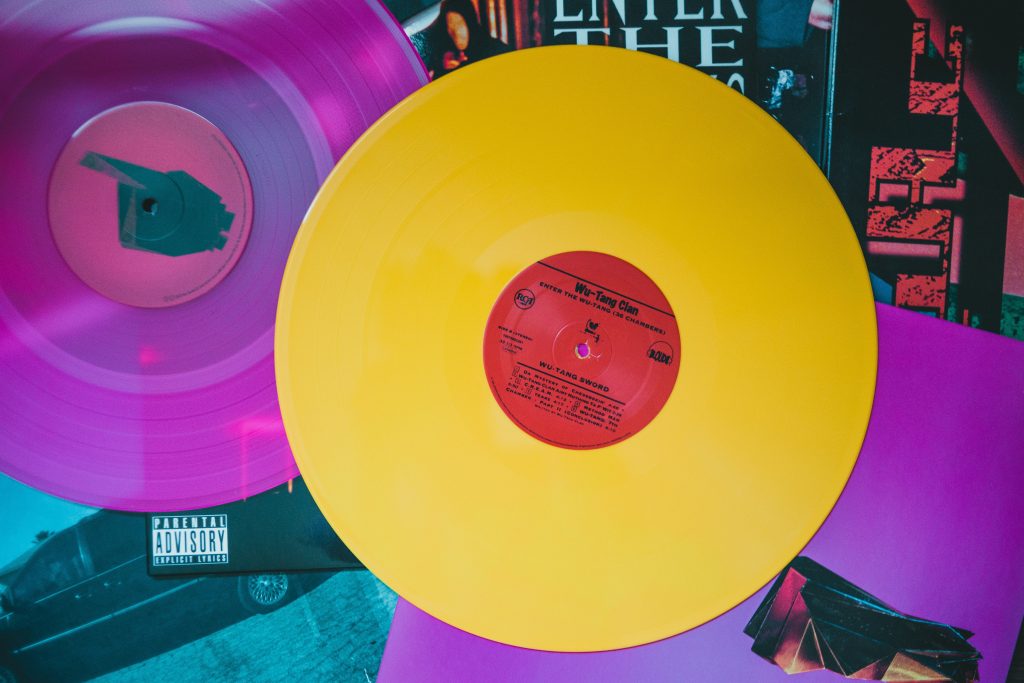
How to create an eye-catching album cover art
Now that we better understand why creating eye-catching artwork for your album is so important, let’s have a look at some top tips to make your album memorable.
Stick to your identity
You can narrow your design options by focusing on your identity as an artist or band. Whether you’re a rock band, a country singer, or a pop artist, your identity should shine through your album art. It should capture the attention of your intended audience.
You can likewise take notes from the digital presence you’ve already established and maintained. Figuring out your identity and the key elements of your music can help you find the proper subject for your album art, whether you choose photography, typography, or abstract art as your primary medium.
Use design concepts
Because music often feels intangible, it’s helpful to harness the power of visual elements to evoke specific responses. You can look into color strategies such as color psychology and color schemes to create dynamic visuals. For instance, monochromatic schemes can tap a certain mood or signal the listener that the artist wants the music to speak for itself.
Using design concepts in your album cover art, such as minimalism, grunge, or retro art, will also give listeners an idea of the music on the album.
Maximize your medium
Your album artwork will heavily rely on the medium you use. Whether you decide on a photo, illustration, or graphic, the medium will determine the strength of the emotional connection you will have with your audience.
For example, the famous cover album of Nirvana’s Nevermind, which features a baby swimming after a dollar, has sparked timeless nostalgia and continues to be iconic 25 years after its release. Some albums have also utilized digital alterations of paintings to convey a particular message.
Collaboration and creativity are vital to creating unique and timeless cover art. The visual component of how we enjoy music is increasingly recognized as an integral part of our online listening experience.
After designing a one-of-a-kind artwork, it’s also important to share it on the right channels. Vampr is a great place to get feedback on your album artwork. Connect with other musicians, producers, designers, and more and ask what they think. Are they getting the messaging you were trying to convey? You might even offer a perk for anyone sharing valuable feedback with you.
Remember, artwork just like music is subjective. Feedback is helpful, but you are the one that the artwork needs to resonate with long term. Create something you are proud of and release it into the world!
Ideas to create a memorable album artwork
Your album artwork should capture the attention of your audience and give them an idea of the music on the album. But if you’re an emerging artist, you may not have much budget to make your album cover art.
That’s not a problem. We’ll show you how to create album artwork on a budget.
Making an album cover on a budget
First, you need great photos.
Here some of the best places to look for royalty free images (some are free):
- Canva
- Pixabay
- Pexels
- Unsplashed
- Pxere
Then, you need a tool for editing images and making them your own. Some of the best ones are (some are free):
- Figma
- Canva
- Designer.io
- Photoshop
Album cover art specifications
Another important thing to keep in mind when creating your album cover is the size and specifications of your artwork.
Major streaming platforms like Spotify and Apple Music require that album arts meet certain criteria in terms of size, shape of the image, format, quality, and so on.
For example, Spotify has the following cover art requirements:
- Format: TIFF, PNG, or JPG using lossless encoding
- Highest resolution available
- Minimum 640px wide and tall
- 1:1 aspect ratio
- Encoded with an sRGB color space, 24bits per pixel, with color profiles applied directly
- They don’t allow upscaling images and they don’t support embedded color profiles and orientation metadata.
Creating the best album cover art
All in all, album art is a key element of an album as they are key to the audience’s first impressions and music discovery.
To make a memorable album artwork, you should stick to your identity, use the right design and choose the appropriate medium.
The good news is that you can create album cover art on a budget. There are plenty if free tools to look for royalty free images and edit images that allow you to create beautiful designs without spending much.
Want to release your music? Make sure you have all bases covered with our Music release checklist for emerging musicians.
By Queenie Kirk, edited by Leesa Snider and German Rodrigo
What did that punter mean when they said the show was good but the guitar was too loud? How do you listen and deconstruct constructive criticism and use that to improve? Criticism is the act of giving your opinion or judgment about the good or bad qualities of something or someone.
Remember that criticism and music are subjective
Firstly, there is no hard and fast rule on what “good” music is. Music is entirely subjective and this means one person’s notion of great music can be entirely different from the person standing next to them. It’s often hard to take criticism because the music that you give to the world is ultimately a sonic expression of yourself. Often it is the rawest and most vulnerable parts of yourself that create your best work. Not everyone will agree it is your best work. This is based on what they grew up listening to, who their friends listen to, which artists were the most popular during their lifespan, and likely many more reasons.
So, in light of this – attempt to not take any criticism personally. Note that we use the word “attempt” because this is in all likelihood not entirely possible in every situation. We have all had our parents tell us to stop with that racket when we were practicing in our rooms as teens. It’s hard to not take criticism personally because it feels like a critique of you as a person. But, if you want to grow and learn as a musician, you need to strive to separate these.
Ask people who understand music to give you criticism
We all have those friends and family members who love to give us critiques at all moments of the day. It comes from a caring place, but it’s not always helpful. What is helpful is getting critiques from professionals in the industry who understand the fundamentals of music. The opinions of audience members are still important, but can only go so far as their expertise.
When you have music lessons, ask your teachers for critiques. Ask your fellow musicians for their opinions. The more granular you get, the more nuance you can create in your playing. Having other musicians around you who are better than you is crucial to improving. If you are the best player in the room, you have no one to aspire to. Make sure to surround yourself with people who have more expertise and knowledge to pass along. The path to improvement is to be the little fish in the big pond.
There’s no need to take on board everyone’s critiques
Whether people have valid points about your music or not, not everyone’s critiques need to be implemented. You need to take into account what kind of player you are trying to be. If you have a professional musician offering you constructive critiques on your sound, stop for a moment and think about what they sound like.
They can only teach you what they know. Do you like their sound? Do you want to sound similar to them? Or, are you going for a completely different sound? Don’t just blindly follow expert advice without first thinking about the overall impact on your playing and whether that is something you want.
Your biggest critic is yourself
No one knows you better than you. And simultaneously, no one is harder on you than yourself. Be kind to yourself. You play music because you love it. Take it seriously, but remember why you started. Be open to the idea that you can be better and know that it’s okay to have room for improvement. Figure out the ideal way for you to receive criticism. Is it with gentle encouraging words? Perhaps you require negative reinforcement to drive you to practice more.
You need to know yourself enough to know how you can improve efficiently and effectively. Think back to a time when you experienced a spike of improvement or growth in your playing. What came before that? Did someone compliment you on your playing? Maybe you had a really intense music lesson with lots of actionable and practical tasks that resonated? Perhaps your band member told you that you need to practice a specific part of the song more.
Identify and lean into the method that suits and serves you the most.
Want to know more? Read What Did They Really Mean? Learning How To Take Criticism and Improve Your Art.
When you are an emerging musician, it can be tricky to build an audience and know exactly who your fans are. How do you find people who will resonate with what you are creating? The answer is… there is no one answer!
Identify your audience
There’s no point making wild guesses about who your fans are. You could be completely off the mark. Luckily, with social media analytics being what they are today, you don’t have to make an educated guess about who your fans are, the analytics already have that information ready and waiting for you!
It is true that you need over 100 followers to start gleaning data on who is following you. This is a very achievable first step and once you get there, you can start building based on your audience demographics.
Every single social media platform has built-in analytics that tracks several things about your audience.
These things include:
- where your audience is located
- how old they are
- what language they speak
- when they are most active
- their gender
- Which posts they engaged with the most
- Which posts got the most reach
This information is freely available to you. All you have to do is have a business account and you will get access to this critical information.
Now that you know who your fans are and what they prefer, gear your content towards their interests to further build your audience.
Use the information you have about your current audiences to build more similar audiences. Give them what they have already shown you they want!
Test and trial content.
Each month, trial new content and then check back on the analytics to see what performed the best. Lean into content that is doing well and create more in a similar vein. Make sure you are doing the basic things to appease and optimize the algorithm.
These things include:
- Post regularly and consistently
- Use appropriate copy for particular platforms – (Relevant hashtags for Instagram, no hashtags for Facebook)
- Really think about the copy you are using and if it is encouraging people to stop and read
- Eye-catching assets
- Don’t just stick to one asset format, rotate between them all (carousel, image, video)
- Geo tagging
- Tagging any collaborators with the correct handles
Social media is meant to be just that, SOCIAL. Make sure you are interacting with anyone who is commenting or engaging. You can’t expect others to stay in touch with you if you aren’t reciprocating!
Never pay for bots to build your audience.
Why? The way these bots work is they go onto other accounts as you and like, comment, engage and follow to encourage that account to do the same back. When that account does follow you back, the bot then unfollows them so your following count stays low whilst your follower count gets higher. This looks good from the outset, but you can always tell when a bot has been at work because organic engagement numbers do not at all correlate with the number of followers you end up with. In short, you paid for a single number to go up but this number will not have the same impact it normally would if you built it organically.
This is a waste of your money and never truly reflects an authentic audience.
Often, bots won’t pick accounts that are super relevant to you or your interests. This means that eventually you are left with a bunch of accounts that are not interested in your content and are likely to eventually unfollow you. It also skews your data and analytics on the back end. You may notice more random audience members in different countries that don’t relate to you or age groups that are not in line with the style of music you perform.
BUT, you can still pay for followers in a careful and calculated way. Facebook Ads Manager has a campaign objective that is aimed specifically at obtaining more follows and likes. Ads Manager allows you to granularly target the audience that will receive this ad from you. Thus, allowing you much more control than if you were to just pay for a bot. These audiences can be lookalikes of your current audiences. A lookalike audience can have different levels of similarity, but you can select that they are similar by 1% meaning they are as similar as possible without being the same person!
This is a safe and strategic way to build an audience and find your fans on top of a consistent social strategy.
Build your audience by making friends at live shows!
Whether you are supporting or headlining, aim to connect.
Every time you play, you should hang around and talk to the people who came to see you. These are your literal fans in the flesh! Don’t waste a moment and try to get to know them. This will give you even more insight into what your audience looks like and presents as in real life. It is the perfect chance to connect with them on a deeper level and thank them for showing up to support you.
If you are supporting another band or you are the headliner, always be kind and friendly to the other band. Generally, support acts and headliners tend to choose similar genres in order to create flow during the night. This means that the other band’s audience may also be potential fans of your band. Always tag and share a gig if you are supporting, not just to show literal support, but to get in front of the eyes of their audiences. Ideally, you will get some cross-over the more you perform with different bands and your audience will compound and become larger.
Want more in-depth information? Read How to build an exemplary online presence.