

What level of accessibility is your online content? It is important that we think about the audiences who want to engage with us online. Can they easily access information about you as needed? This can be achieved by putting some standard practices into play.
What is accessibility?
“Accessible” means a person with a disability is afforded the opportunity to acquire the same information, engage in the same interactions, and enjoy the same services as a person without a disability in an equally effective and equally integrated manner, with substantially equivalent ease of use. The person with a disability must be able to obtain the information as fully, equally, and independently as a person without a disability.”
Is your online activity structured in a way that allows ease of access?
Inclusive and accessible language.
Disability or disabled can feel like a scary word. Is it politically correct to use the word disabled?
Absolutely. Disability is not a bad word. It’s a word that describes a proud community of incredible people. The disabled community is the one group that any race, gender, or diverse person can be a part of. It’s the one group that spans beyond who you are and what you look like. It is also the one group that we should all strive to be a part of later in life. If you become old enough, you will likely join this community. So why don’t we have more representation, more inclusion, and more access for such a large group of people?
What language should I use when referring to people with lived experience?
- Deaf or hard of hearing
- Blind or low vision
- Short statured
- Wheelchair-bound
- Neurodiverse
- Person with disability or disabled person depending on the preference of the individual.
Whenever in doubt, ask someone with lived experience!
Online Accessibility.
Statistics from World Health Organization (WHO) show that 20% of the population is disabled. If you exclude people with disability, you are ignoring a large part of the population who could be your personal super fans. Those people could bolster your audience drastically if you are inclusive.
Practices you can implement to improve accessibility include but are not limited to:
- Website access tools
- Image Descriptions
- Alt text
- Capitalized hashtags
- Subtitles
- Closed captions
- Accessible live-streaming
- Championing other disabled artists on your channels
- ASL interpreters on digital events or on live recorded events
- More representation
Website accessibility.
It is important that anyone with a disability can access your website and change the formatting so that it can be made accessible for them. A great tool for this is User Way. User Way allows you to incorporate some code into your website that presents as a widget for the website visitor. When clicked, this icon offers an array of options to make the website more accessible.
These options include:
- The ability to adjust website contrast
- Highlight links
- Bigger text
- Wider text spacing
- Pause animations (for anyone with epilepsy)
- Dyslexia friendly adjustments
- A larger curser
- Line height for text
- Text alignment
- Saturation
There is a free and paid version of this tool.
Accessible image and video descriptions.
Video content is the most popular and engaging form of content in the current digital landscape. Don’t you think everyone should be able to access the content that you and everyone else has been sharing?
Image/video descriptions are textual descriptions of visual content such as images, videos, or graphics. They are intended to provide information about the visual content to individuals who are blind, have low vision, or have other disabilities that prevent them from perceiving the visual content.
These Image descriptions can be added to digital media, such as websites and social media posts to make the content more accessible to all users. They should be concise and descriptive, providing enough information to convey the purpose and content of the image.
They can also be used to enhance search engine optimization (SEO) and improve the accessibility and usability of websites and digital content for all users. They are an important aspect of web accessibility and inclusive design, helping to ensure that digital content is accessible to everyone.
Include alt. text.
Ever hovered your mouse over a spot where an image should be but it is coming up blank and all that you see are some words describing what should be there? Imagine you haven’t ever been able to see that image. Alt. text is there to help describe what you might not be able to see.
Alt text, also known as alternative text, is a textual description of an image that is used to provide information about the image to users who may not be able to see the image. Alt text is typically used by screen readers and other assistive technologies to help visually impaired users understand the content of an image.
This text should be concise and descriptive and should also be relevant to the context in which the image appears. Alt text can be added to images in HTML code and should be included whenever an image is used on a website or in other digital content. This is the main difference between image descriptions and alt. text.
Including alt text is crucial as it is an important aspect of web accessibility and inclusive design, as it helps to ensure that all users can access and understand the content of a website or digital media.
Capitalized hashtags
It might be easy to type your hashtags in all lowercase letters, but those extra seconds you take to capitalize them properly could mean the difference between someone being able to understand your hashtags or not.
Capitalized hashtags are hashtags that use capital letters to distinguish between words within the hashtag. For example, #BlackLivesMatter is a capitalized hashtag that uses capital letters to differentiate between the words “black,” “lives,” and “matter.”
The Capitalization is often used to make the hashtag more readable and understandable, specifically when it comes to accessibility and particularly if the hashtag contains multiple words. Capitalizing each word in the hashtag can also help to improve its visibility on social media platforms, as some platforms use algorithms that recognize capitalized words as separate keywords.
It’s worth noting that while capitalization can make a hashtag more readable and recognizable, it doesn’t affect how the hashtag is used or searched for on social media platforms. Users can search for a hashtag whether or not it’s capitalized.
Live-streaming and ASL interpreters.
Have you ever held a live-stream event? It was all the rage during the pandemic… and also the only option. Did it occur to you to incorporate some accessible tools to make the event more inclusive?
Accessible live streaming refers to the practice of making live video content, such as webinars, conferences, or live events, accessible to people with disability. This includes providing accessibility features such as closed captions, sign language interpretation, and audio descriptions, as well as ensuring that the live stream is compatible with assistive technologies such as screen readers.
Here are some tips for creating accessible live streams:
- Provide closed captions: Closed captions display a transcript of the audio content on the screen, making the content accessible to people who are deaf or hard of hearing. Many live-streaming platforms offer built-in captioning tools or integrations with third-party captioning services.
- Include sign language interpretation: Sign language interpretation can be provided through a separate video stream or by having an interpreter on-camera. This makes the content accessible to people who are deaf or hard of hearing and use sign language.
- Use audio descriptions: Audio descriptions provide a verbal description of the visual content in a video, making the content accessible to people who are blind or visually impaired.
- Ensure compatibility with assistive technologies: Live streams should be designed with compatibility in mind, ensuring that the content is accessible to people using assistive technologies such as screen readers or magnifiers.
By implementing these practices, live streams can be made more accessible and inclusive, allowing people with disability to fully participate in the content and engage with the material being presented.
Subtitles and Closed captions
Subtitles are textual versions of the dialogue or narration in a film, television show, or video. They are intended to provide a written representation of the spoken words, allowing viewers who are deaf or hard of hearing to understand the content. Subtitles can be displayed either on the screen, as part of the video itself, or as a separate file that can be turned on or off by the viewer.
They can also be used to provide translations of dialogue that is spoken in a language other than the primary language of the video. This is often referred to as “closed captioning” or “subtitles for the deaf and hard of hearing” (SDH) and is typically used in television shows and films that are broadcast internationally.
SDH and closed captioning are valuable tools for improving the accessibility and inclusivity of video content and are increasingly used in online media such as YouTube videos, online courses, and webinars. They can also be used to improve the overall user experience of video content, allowing viewers to watch videos in noisy or quiet environments or in situations where they are unable to turn up the volume.
Ask yourself, do I take the time to include subtitles in all of my video content? Did you know that you can tap a captioning sticker in both Instagram and TikTok that auto-generates your captions from the video? Game changer!
Championing other disabled artists on your channels
Don’t be afraid to spotlight and champion artists with disability who are already making headway in the industry. Champion them like you would any other artist whose music you adore. Take a moment to look at what they are doing and see if you can implement any strategies that will make your online presence even more accessible.
More representation
The more we implement these standard accessible practices, the safer people with disability will feel when entering the music industry. With more accessibility and inclusivity, the more representation we are likely to see more from the disabled community.
This starts with you! Make sure you are doing everything you can online and in person to make your music inclusive and accessible. Ask a musician with lived experience to support you at your next show, or offer to support them! We all need to do our bit to cause a change in the music industry.
Go and try out your screen reader
Every phone has screen reader capabilities in the settings. To try it out for yourself, follow the instructions below.
Go to:
- Settings
- accessibility
- Voice over
- Voice Over practice (go here)
- Voice Over learn more to learn the cues
- Choose the speaking rate
- Once you feel familiar with the cues, close your eyes and try to navigate around your phone.
- Finally, go to social media and see how easy it is to understand when your eyes are closed and you are using a screen reader.
Interested in learning more about accessibility? Go and read >> How to make your performances more inclusive and accessible.
“Is this show financially viable for the band and myself?” Or, in other words, will I make money from this show? It is so important to ask yourself before you lock in a performance. Is it worth the time and effort that you are about to commit? There are a bunch of ways you can figure this out before you jump in head first!
Financially, what are your responsibilities?
The best way to learn about your financial obligations is to ask upfront! Make sure you know the answers to the following questions before saying yes to a gig.
You may ask:
- Is it entirely up to you to sell tickets?
- Will you need to find supports? Financially, is it your responsibility to pay them?
- Are you headlining? What does that mean in terms of responsibility?
- If you don’t sell all the tickets, what will happen? Will you owe anyone money?
- Do you need to make posters? Do you need to print them?
- Am I required to drop off a certain size of the poster so they it can be pasted around the venue?
- Do you need to provide social assets to the venue?
- Do you need to provide backline for your band and the supports or is there a house set up?
- Will you need to bring your own sound engineer or will it be supplied?
- When will the ticket link be active and available to share? What is needed from you to make this happen quickly?
- Is it your responsibility to make a Facebook event?
Understand the venue’s responsibilities.
Just as it is important to know your responsibilities, it is also key to know how the venue will support you financially and promotionally if you say yes to this performance. Some venues are more hands-on than others and you need to clarify exactly what the venue needs from you and what they will do for you to help sell tickets.
You might ask the following:
- What will they do to help you sell tickets?
- Is an in-house sound engineer provided or do you cover this financially?
- Is payment made on the night or via an invoice?
- Will they email their subscriber list?
- Promote on radio carts at their own financial expense?
- Promote it in street/online magazines.
- Pay for Facebook ads?
- Distribute posters?
- Post on socials?
- List it on their website?
- Is there an in-house photographer who can take pictures or videos?
- On the night of the show, what will be provided to you and the other bands?
- Will a green room be available?
- How many comp tickets will there be? (This will help you accurately build your budget)
- Will there be a rider provided? Food, drinks? How many per person?
- What will the set times be? How long are you all required to play for? (Make sure you are not agreeing to 2-hour long sets!)
- Are you being given a night where most people will actually attend? Thurs, Fri, Sat?
- When will you have access to the venue?
- What time is soundcheck?
Even though some of these questions are logistical, they all pertain to the amount of effort you may end up putting in throughout the lead-up to the show and on the night.
Think about what type of financial offer has been made.
There are an array of deals that occur in the music industry. If you have begun performing, you will no doubt have experienced at least a few of these.
Here is an outline of the main deals that exist:
Door deals.
A door deal is a common type of agreement between a live music venue and a performer or band. In a door deal, the venue and performer agree to split the revenue from ticket sales.
Here’s how it typically works:
- The performer and venue agree on a ticket price for the show.
- The venue sells tickets to the show and collects the revenue.
- After the show, the venue deducts any expenses (such as sound or lighting equipment) from the total revenue and splits the remaining revenue with the performer according to the terms of the agreement.
A typical door deal might be a 70/30 split, where the performer gets 70% of the revenue and the venue gets 30%. The percentage split can vary depending on the negotiating power of the performer, the size of the venue, and other factors.
Is it a good deal?
A door deal can be a good option for performers who are just starting out or who are playing at smaller venues. It allows them to keep a larger portion of the revenue from the show, rather than having to pay a flat fee to the venue upfront for hire.
However, door deals can also be risky for performers, since they have to rely on the venue to accurately report ticket sales and expenses. It’s important to have a clear and detailed agreement in place to avoid any misunderstandings or disputes. It’s also risky because if you don’t sell enough tickets to cover the expenses, you may find yourself owing money to the venue for sound and lighting.
A versus deal.
These deals are quite confusing! Let’s use an example to make this as clear as possible!
If the deal is a $2,000 guarantee vs. 70% of $30 full-priced tickets + 70% of $25 concession tickets, and the capacity is at 300 people.
What this means is that regardless of whether you sell 0 tickets, you are guaranteed $2,000. However, if you want to earn more than that, you have the opportunity to by selling more tickets. Once you reach over your $2,000 guarantee in ticket sales, you have the chance to earn additional money.
Consider this, if you sold 100 full-priced tickets you are entitled to 70% of those sales.
- 32/100 x 70 = $22.40
- $22.40 x 100 = $2,240
By selling 100 tickets and calculating 70% of those ticket sales, you have made $2,240. This is already higher than the $2,000 guarantee and this is the amount you would walk away with.
If you sold 300 full-priced tickets and calculated 70% of those sales it would look like this:
- 32/100 x 70 = $22.40
- $22.40 x 300 = $6,720
By selling out you stand to make $6,720 instead of just the guaranteed $2,000! This gives artists an incentive to sell more tickets but also alleviates them of the large risk of underselling tickets with the guarantee in place.
Don’t forget!
One thing to be careful of here is the concession prices. You want to look at worst-case scenarios just in case. If you sold all 300 tickets at concession prices only it would look like this:
- 25/100 x 70 = $17.50
- $17.50 x 300 = $5,250
This is the lowest possible amount you could make from selling out. Make sure you plan for some financial flexibility when it comes to this deal. Don’t overspend on other things before you have assurance you can make up the difference.
A guarantee.
We love these! A guarantee is very straightforward and is what it sounds like. You are guaranteed a certain amount of money for your performance. No matter how many tickets are sold you will still be paid the same amount. This is a really nice and stable offer to get. It tends to happen when you are more established and the promoters or venue bookers know you have a loyal audience that will show up regardless.
Cost per person.
A venue may also take a small fee off the top of each ticket. For example, if you agree to make the cost of a ticket $22.50, a venue may take $2.50 off the top of each person. This leaves you with $20 per person instead. If there’s a large number of people attending this can really add up and be problematic. This needs to be carefully thought out in terms of pricing the ticket. You don’t want to go so high that the price is unappealing, but you also don’t want to underprice and end up creating financial issues for yourself and the other bands later.
The best thing to do is calculate your expenses and then price your ticket so that you can realistically afford the event.
Venue hire fee.
Venues will often charge a venue hire fee which can range from $200-$1000+. It all depends on the size and caliber of the event and venue. Sometimes this is a stand-alone fee and sometimes it is in addition to a door deal or versus deal. Once again, make sure that however you are making money from this performance you calculate your expenses and ensure you can realistically pay for everything you need.
Percentage deal.
These deals are also exactly how they sound! You get a percentage of either ticket sales or the bar takings during your show or maybe both! It all depends on what agreement you come to with the booker. Make sure you ask for a high enough percentage that this is worth it for you!
*Side note – this list in no way covers all of the potential deals you may encounter. However, being across these will help you decipher whether any other versions of these deals are worthwhile!
Create a budget to test whether it is financially viable.
Go through the worst-case scenario and see if this is worth your time. Ask yourself, what is the worst thing that could happen? If you sold zero tickets how much money would you owe? Is that amount something you can justify financially?
Don’t forget that time is money! Ask yourself, how many hours am I really committing to this and what is that worth? It could be worth calculating how many hours you anticipate spending on this event in its entirety and adding a reasonable hourly rate for yourself into the budget as payment.
Create a profit and loss spreadsheet and estimate what you stand to make or lose. Don’t forget any booking fees or venue hire fees.
Think about all of your expenses and write them out. Your expenses will be a combination of set fees and flexible ones. The flexible ones may be what you can pay your band members and supports if the show does well. It might also be more finances to spend on ads and promotion. For now, put the bare minimum that you would like to include.
Expenses and Revenue.
Expenses might include but are not limited to:
- Support act fee
- Sound Engineer fee
- Marketing fees (ads, posters)
- Paying your band members and yourself
- Your time
- Lighting technician
- Venue fee
- Booking fee
- Petrol costs
- Food/drinks
Revenue might include but is not limited to:
- Ticket sales
- Merch sales
- Percentages of the bar
Profit and loss.
Do the maths and figure out how many tickets you need to sell to break even. That means you don’t make money and you don’t lose money. This doesn’t necessarily mean this is financially viable yet. Then, ask yourself, how many tickets do you need to sell to make money? Is that number realistic? Be very prudent about answering this question. It could be the factor that makes this show something that will help or hurt you financially.
This bottom line should help you make up your mind about the financial viability of the show. That means when you deduct your expenses from your revenue, what are you left with? How hard will you really have to work to sell tickets from this starting point?
Have a well-rounded strategy.
Take your time.
When you first get an offer from a venue, even though it may be exciting, give yourself time to process what that offer entails financially and time-wise. Many bands are just so thrilled to have an opportunity to play that they rush into an agreement and then find themselves in way too deep with commitment. Make sure you understand the deal, ask questions and ascertain where your responsibilities begin and end.
Delegate.
Delegate tasks to others and don’t try and do it all yourself! Ask your support acts to promote the gig on their socials, and give your bandmates a social tile to share on their personal profiles as well! The more reach you have the more likely more people will come. Message people personally as well. There’s nothing quite like having someone invite you directly to something. It leans on the notion of that person being important and a valuable person to have at the gig. It also shows that you took the time to think about them and put the effort to ask them individually.
Use social media and individual messaging.
Have a social media and promotional strategy ready to run from the announcement of the gig up until gig day. Don’t just accept the offer and then wait until the last second to hussle and sell tickets. Ask to be added to weekly ticketing updates so you can track how sales are going and start planning some posts to get people’s attention. It’s also worth running some ads to similar audiences so you are upping the chances of new people with similar interests attending.
Weigh up the non-financial value.
If this isn’t a financially viable performance and that is clear based on the budgeting and discussions you have had, the other way to see if a performance may be viable is to weigh up other kinds of value that this gig may produce.
For example, the venue may be a prestigious one and it could add serious clout to your reputation if you played there even once. You are getting some free live footage that you could use for social media promotion down the track. Or, the venue patronage may be an audience group that is very well-suited to your target audience and this is a prime opportunity to reach more like-minded fans. This may mean the gig is still worth playing regardless of a loss financially.
Either way, you should use your better judgment to decide whether any of these other reasons are valuable enough to go ahead with the performance regardless of finances.
You could even think ahead to your future self and ask yourself, will I feel frustrated after the fact if I say yes to the gig for any of these reasons? If you get that irked feeling – say NO! It is important to listen to your gut and stand up for what you are worth! Set the standard so other musicians follow suit.
Want to be completely across your business affairs? Vampr Academy has a Music Business Essentials course exactly for this! >> Start a free trial now
New releases from our Vampr community! 🔥
For January we have chosen to spotlight 5 members who have been busy collaborating! Vampr wants to pay homage to our incredible community by shining a spotlight on their experiences. We have so many artists releasing insane music and living their best musical lives – we want to spotlight as many as possible!
We always love hearing about community success and collaborations. This is why we do what we do! Check out who our top 5 fave spotlights are this month. 👀
Spotlight 1: Producer Swoon Shop x FireVerse
Producer Swoon Shop is a beatmaker/producer addicted to dancehall, reggaeton, afrobeats, reggae, hip hop with brand new beats for artists coming up consistently. He is always up for a collab and is from Germany. Producer Swoon Shop found FireVerse from Jamaica on Vampr and they collaborated to make a song Place Bun Up.
Fabian Wayne Edwards professionally known as FireVerse is a Jamaican dancehall and reggae artist from Mandeville, Jamaica. He became active in early 2021 and has released albums on the record labels, WrldClassic Records. FireVerse is popularly known for his single Reggae Music which features reggae legendary Singer-songwriter Luciano and Kraative, the song was produced and released by WrldClassic Records in 2021 that gained popularity in 2022 a year after that led FireVerse with an interview with Calipost.
–
Listen to the track HERE
Spotlight 2: Germán Vergara
German from the band Chilean Prog Rock Band Aisles who found their last Singer using Vampr is looking through our vast network yet again to find another Lead Singer for their band.
Based in Santiago, Chile, and having released four highly acclaimed studio albums, Aisles have become South America’s most important progressive band of the past two decades.
The group has played in the Americas, and Europe, and done extensive touring cycles in Chile, opening for household names such as Marillion and Focus.
Their latest studio album, ‘Hawaii’ (2016), was called a “masterpiece” and chosen among the best albums of the year by media outlets such as Prog (England), IO Pages (Holland), Raw Ramp (England) and Chile’s premiere rock magazine, Rockaxis.
After parting ways with long-time vocalist Sebastián Vergara in late 2018, Aisles have found a new singer and starting anew with a different line-up and a fresh sound. The band is currently releasing new music, leading up to their fifth studio album, to be published in the first semester of 2022. Their newest single, Thanks to Kafka, was released on October 29th, 2021, through Presagio Records.
Listen to their newest release and hit them up if you think you might be the right fit!
–
Listen to the track HERE
Spotlight 3: Jacob Cook x Chase Coultier
Jacob Cook is a 22-year-old independent indie-folk based in Manchester, UK. With over 10 million streams on Spotify worldwide, he’s known for his chilled Acoustic covers. Covering a range of genres alongside original material. His music draws inspiration from artists such as Bon Iver, Ben Howard and Henry Jamison. His cover of Soldier, Poet, King hit international fame has over 50k featured TikTok videos to alongside it. Jacob’s vocals are smooth yet powerful and create a deep sense of nostalgia and longing for the listener.
Chase is keen to work on a track together! He’s looking for indie/pop artists specifically. Chase is a sound engineer + touring playback/Ableton tech. He’d love to help build your playback rig!
–
Listen to the track HERE
Spotlight 4: AfterAudio
AfterAudio is an independent musician that is looking to connect with people through music. He performs rock originals and writes electronic music live on stream.
–
Listen to collaborations HERE
Spotlight 5: Leanna Kleppick
Leanna Kleppick and AfterAudio also collaborated together on a track called Silver Bells. Leanna sang on the track and AfterAudio produced.
–
Listen to the track HERE
Have you got some Vampr successes you are dying to share? Hit us up on [email protected] and you may be included in next month’s top spotlights!
The first step to getting your music on Spotify is to claim your profile. In this guide, we’ll show you how to claim your Spotify for Artists profile and publish your music.
Never released music on Spotify before? Have you got a final recording mixed and mastered and ready to go? But you have realized you can’t just log into Spotify and upload your tracks like you would with Soundcloud. We got you, follow the simple steps below to find out how to claim your Spotify for Artists profile.
What you need before you claim your Spotify for Artists account
Before you even think about trying to claim your Spotify for Artists account, you need to make sure you have the following:
- A final mixed and mastered track in wav. and mp3. formats.
- Artwork that is exactly 1:1 ratio (square) and at least 640 pixels wide and tall.
- The lyrics to the song.
- The agreed-upon song splits for copyright.
- A header image that is at least 2660px x 1140px.
- A profile/avatar image that is at least 750px x 750px.
- Any gallery images you want to include in the About section, must be at least 690px x 500px.
- A bio that is no longer than 1500 characters.
Choose your distributor
If you are an independent musician, you will likely not be signed to a label that would normally handle your distribution. In this case, you need to pick a distributor who will send your music to stores like Spotify. Some examples of distributors you can use are Ditto, CD Baby, Tunecore and even Vampr Distribution!
These online distributors do not take any copyright, unlike a label. Instead, they may take a one-off fee or a subscription fee that is very affordable.
Once you have chosen a distributor, they will ask you to input your metadata. That means you will include:
- The track
- The title
- The track artwork
- Song splits and contributor names
- Lyrics
Once this is submitted and your distributor has sent it to stores, you need to request the artist link or URI from the distributor. You can claim your profile only once your music has been ingested on the back end. This shouldn’t take too long, usually only a day or two.
Claim your Spotify for Artists profile
Now that you have the artist link or URI, you can claim your Spotify for Artists profile!
Head to this link to get started: https://artists.spotify.com/en/claim
Unless you are part of a label team for the artist, you will click on the artist or manager option. You will be redirected to input the URI and then the name of the artist should pop up. Select this and then fill out the required information. You will be asked to verify your account with either Instagram, Twitter or a website to confirm your identity. It will take a couple of days for Spotify to review this and grant you access.
And that’s it! Once you are approved you are in. But wait, that’s not the end of it….
Set up your Spotify for Artist’s profile
Now that you have claimed your Spotify for Artists profile, you need to edit it. This is where some of those assets you needed to have ready previously will suddenly become useful!
Spotify for Artists lets you:
- Add artist images
- Write your bio
- Add an Artist Pick
- Feature an artist playlist
- Add a Fan Support link
Artist Images
Avatar image: Your image in search results and the Spotify mobile app.
- Go to Profile.
- Click the pencil icon in the top-right.
- Under Avatar image, click UPDATE.
Header image: The cover image at the top of your profile in the Spotify desktop app and web player.
- Log in to artists.spotify.com.
- Go to Profile.
- Click the pencil icon in the top-right.
- Under Header image, click UPDATE.
Image gallery: Images in the About section of your profile.
Add, remove, or reorder images in your image gallery. You can add up to 125 images.
- Go to Profile.
- Click ABOUT.
- Click the pencil icon next to Image gallery.
Artist Bio
Use Spotify for Artists to create and update the bio on your artist profile.
- You have 1500 characters for your bio
- Use @tags to link to artists, albums, playlists, and tracks on Spotify
- Paste Spotify links in the text field
- Add links to your social media and Wikipedia page
- Go to Profile.
- Click ABOUT.
- Click the pencil icon next to Bio.Tip: To add links to social media and Wikipedia, click the pencil icon next to More info.
Artist’s Pick
Artist Pick lives at the top of your artist profile.
Use Artist Pick to showcase:
- Any song, album, or playlist
- Your concerts
- Podcasts
You can personalize your Pick with an image and short message.
Keep in mind:
- Your Artist Pick shows for up to 14 days
- After 14 days, your Pick disappears (but you can update it any time)
- If Artist Pick shows a tour, it displays until the day after the last show
- Log in to Spotify for Artists.
- Go to Profile.
- Select + under Artist Pick.
Artist’s Playlist
You can feature any playlist on your artist profile. You can show off a playlist your music has been added to or just show people your music taste, up to you!
First make your own playlist via the Spotify app. Once it is ready, do the following:
- Go to Profile.
- Click the pencil icon next to Artist Playlists.
- Search for the playlist or paste a Spotify link.
Fan Support
This is a really great way for fans to support you. You can raise money for your band, crew or next album. Spotify doesn’t take a cut from these donations.
Your fundraising link must be through an approved partner and there are a select few. These include:
Make sure you pick the payment platform that is relevant to your country and set up an account so you can start receiving support.
- Log in to artists.spotify.com.
- Go to Profile.
- Under Fan Support, click + Get support directly from fans.
- Fill in the Fan Support submission form and click AGREE AND SUBMIT.
Update!
Now that you have claimed your Spotify for Artists profile when your music is released, everyone will see a beautiful profile with images, a bio, ways to support you and find out more about your music taste. Don’t forget when you release new music or get new headshots to update your profile so that it is consistent with your socials and campaign.
If this was helpful, you may also find our Revenue checklist for emerging musicians valuable as well. Read now >> https://www.vampr.me/blog/revenue-checklist-for-emerging-musicians-vampr-blog/
So, you have a website but when you search for it on Google, it’s way down the bottom of the list and you have to really scroll to find it. How do you make sure that your website is in the first few that appear on the list? Introducing… SEO.
What is SEO?
SEO stands for Search Engine Optimization, it is the process of optimizing a website to improve its ranking in search engine results and increase visibility to your target audience.
Okay, but what does that actually look like? And, how do you make sure you are doing everything you need to in order to have great SEO?
In reality this can be very complicated, but to make things simple, there are a bunch of ways you can make your website better and in doing so you convince Google that your site should be at the front of the line.
To have great SEO, here are some best practices:
- Keyword research and optimization
- On-page optimization
- Quality content creation
- Link building
- Mobile-friendliness and speed
Keyword research and website optimization
Keyword research and optimization is an important part of SEO that involves discovering and using relevant keywords in a website’s content and meta-data to improve its visibility and ranking in search engine results. It involves analyzing and selecting keywords that are frequently searched by your target audience and incorporating them in the website’s content, meta-titles, descriptions and other relevant areas in a natural and strategic manner. If it isn’t natural, this doesn’t work, but rather just ruins the flow of copy on your website.
When you include keywords in your site content, it helps search engines understand what the website is about and match it to relevant searches, leading to increased traffic and a better ranking.
On-page website optimization
On-page optimization is the process of optimizing individual web pages in order to rank higher and earn more relevant traffic in search engines. It involves optimizing various elements on a page, such as your page’s content, HTML code, images, and URLs, to ensure that they are search engine friendly and relevant to the target audience.
This includes tasks such as optimizing page titles and meta descriptions, using header tags, internal linking, and making sure the website is mobile-friendly and loads quickly. Effective on-page optimization helps search engines understand what a web page is about, and it can improve the relevance and visibility of a website in search results.
Quality content creation
This is exactly what it sounds like. Quality content creation refers to the production of high-value, informative and engaging content that is relevant to the target audience and provides a positive user experience. The main goal of quality content creation is to attract and retain visitors, establish the website as an authority in its niche, and improve its ranking in search engines.
Quality content can take many forms, including blog posts (like this one!), articles, videos, images, and infographics, and it should be well-researched, well-written, and optimized for search engines with particular keywords and copy. Effective quality content creation helps build trust and credibility with the target audience, increases engagement and shares, and can lead to better rankings and more organic traffic.
Link Building
Link building is the process of acquiring backlinks to a website from other relevant and trustworthy websites. Backlinks, also known as inbound links or incoming links, are links from other websites that point to a specific page on your website. Backlinks are considered a key factor in search engine optimization (SEO) because they indicate the credibility and authority of a website. The more high-quality backlinks a website has, the more likely it is to rank higher in search engine results and receive more organic traffic. You can check authority of a website by using programs like ahrefs authority checker. The quality and relevance of backlinks also matter, as search engines penalize websites for low-quality or spammy backlinks. The trick is to never link to a website that has lower authority than your site.
Link building can be achieved through various tactics, including creating valuable and shareable content, reaching out to other websites for guest posting opportunities, participating in relevant online communities and forums, and leveraging social media. The goal of link building is to increase the number of high-quality backlinks, improve the website’s visibility and ranking in search engine results, and drive more targeted and organic traffic to the website.
Mobile-friendliness and website speed
Mobile-friendliness and site speed are important factors for SEO as they impact the user experience and can affect a website’s ranking in search engine results. You don’t want someone opening your page on their phone and giving up because it is slow to load and isn’t the right formatting for mobile.
- Mobile-friendliness refers to the design and accessibility of a website on mobile devices. A mobile-friendly website should have a responsive design that adjusts to the screen size of the device being used and provides an optimal user experience.
- Website speed refers to how quickly a website loads and responds to user actions. A fast-loading website provides a positive user experience and can improve engagement, reduce bounce rates, and increase conversions.
Search engines prioritize websites that provide a positive user experience and penalize those that are slow to load or not mobile-friendly. Ensuring that a website is mobile-friendly and has a fast load time can improve its ranking in search results, increase its visibility, and drive more organic traffic to the website.
We know this can all seem like an information overload, but every little bit that you do helps to drive your website to the top of the queue. Ultimately, you are trying to convince Google that your website has authority, offers quality and valuable content and should therefore be first in line when people search for artists like you or for similar keywords.
One sheet vs EPK. You’ve probably heard these terms a lot in the music industry. But what are they? What are there differences? Which one should I have? Let’s have a look!
What is a One Sheet?
A One Sheet is a marketing or promotional document that provides an overview of an artist or a band. It is typically a single-page document that includes information such as:
- A high-res headshot or band image
- A short bio
- Career highlights
- New and previous releases
- Track listing
- Images of music released, title, release date, list price, format, UPC, and barcode if available
- Key Markets
- Genre and RIYL (RIYL stands for “Recommended If You Like.” It is commonly used in music reviews and music promotion when describing a band or artist’s sound or style. It’s usually used to give readers an idea of the type of music they can expect and to suggest other similar acts.)
- Press/publicity/management/booking/label contacts
- Social and website links
- Video and music links
What is an EPK?
An Electronic Press Kit or an EPK for short is an online collection of promotional materials that other professionals in the music industry can review. An EPK can include a variety of materials such as biographies, photographs, press releases, music samples, and other promotional materials.
Go and read our latest blog EPKs for artists explained to find out more details of what is included in an EPK.
Is a One sheet the same as an EPK?
Not necessarily, although they do have some similarities.
An EPK tends to be more comprehensive and includes promotional materials such as bio, photos, music samples, press releases, and so on, and it can have different formats (a website, a document, etc). A one-sheet could be a component of an EPK and normally is more concise.
It’s recommended to have both and use one or the other depending on the situation and who the recipient is.
One Sheet vs EPK
Let’s summarize the similarities and differences between one-sheets and EPKs.
One Sheet vs EPK: The similarities
There are quite a few similarities between these two promotional tools. Some of these include:
- Bio
- High-res press shot
- Achievements/Career highlights
- Links to your socials and website
- Music examples
- Music video examples
One Sheet vs EPK: The differences
Each of these promotional packages serves a different purpose. You may notice that an EPK is a folder of items or a long list of things that professionals in the industry will often use to promote a show you have locked in with them. Whether that is from a music venue, publicist, manager, or blogger’s perspective, having this bundle of approved assets that they can use at will to promote you is incredibly convenient and beneficial. Much better than emailing back and forth requesting different assets each time.
A One Sheet is more of a one-page brag. The idea is to only have a single page of succinct information – hence the name one-sheet. This is a better thing to send as a pitching tool in order to secure a gig, write-up, or whatever you are after. It literally highlights the most important parts of your career and tells everyone how great you are.
In comparison, an EPK is less “braggy” and more factual. It contains more details like metadata information. Examples of more detailed assets include lyrics, more detailed explanations of the songs, a longer bio, and often more than one high res photo option, etc.
Do I need both a One Sheet and an EPK?
Both would be great! As mentioned above, both have different uses. You should assess which tool is the most appropriate and will have the best effect in each given situation.
I might send a one-sheet to a venue booker first as an initial pitch so I can play my album launch there. After that has been locked in, I would send my full EPK to the organizer, a publicist, radio presenters, etc. See how both of these tools work in tandem with one another.
However, if you had to pick one – an EPK is an essential promotional tool that is necessary to be taken seriously and as a professional, as well as the most convenient way to store, organize and share your artist information.
Vampr EPKs
Did you know that your Vampr profile also doubles as a free EPK?! You’re welcome. You can use your Vampr profile as a landing page for your EPK and all you need to send industry professionals is your profile link – so easy! And more importantly, it’s FREE!
How does it work?
Once you create your profile in the app, a web profile is also automatically created. You can customize your profile in the app as usual, and add pictures, media, vamps, recordings, socials, etc. You can also change the order of the items on your profile in the app. These changes will automatically reflect on your web profile as well!
Use your Vampr profile as your professional EPK and send it directly to booking agents, publicists, headlining acts, press, and whoever else you might want to pitch to!
How do I find my Vampr EPK?
There are 2 ways to locate your Vampr EPK on the app.
- Go to Edit Profile and scroll down to Web Profile. You can tap the link to open it or tap the icon to copy the link to your web profile
- Head to your profile (View profile) and click the Share icon on the top right. You will see 3 options: to either copy the link, view your web profile, and share it via email or social media platforms.It’s that easy!
Alternatively, you can pull your handle and replace it on this link where it says handle: vampr.me/artist/handle
For example, our Vampr CEO Josh has his own EPK at vampr.me/artist/josh
What does it look like? Here is a little sneak peek… 👀
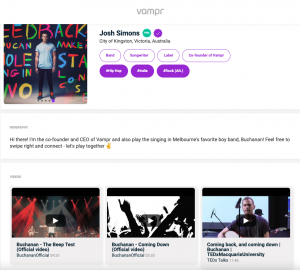
Click on the image above to view Josh’s full Vampr EPK.
So, what are you waiting for? >> Go make your free Vampr EPK now!!